Date: 8 Apr 2025
Event coordinators: NISHANT PATIL , Abhishek Abhang
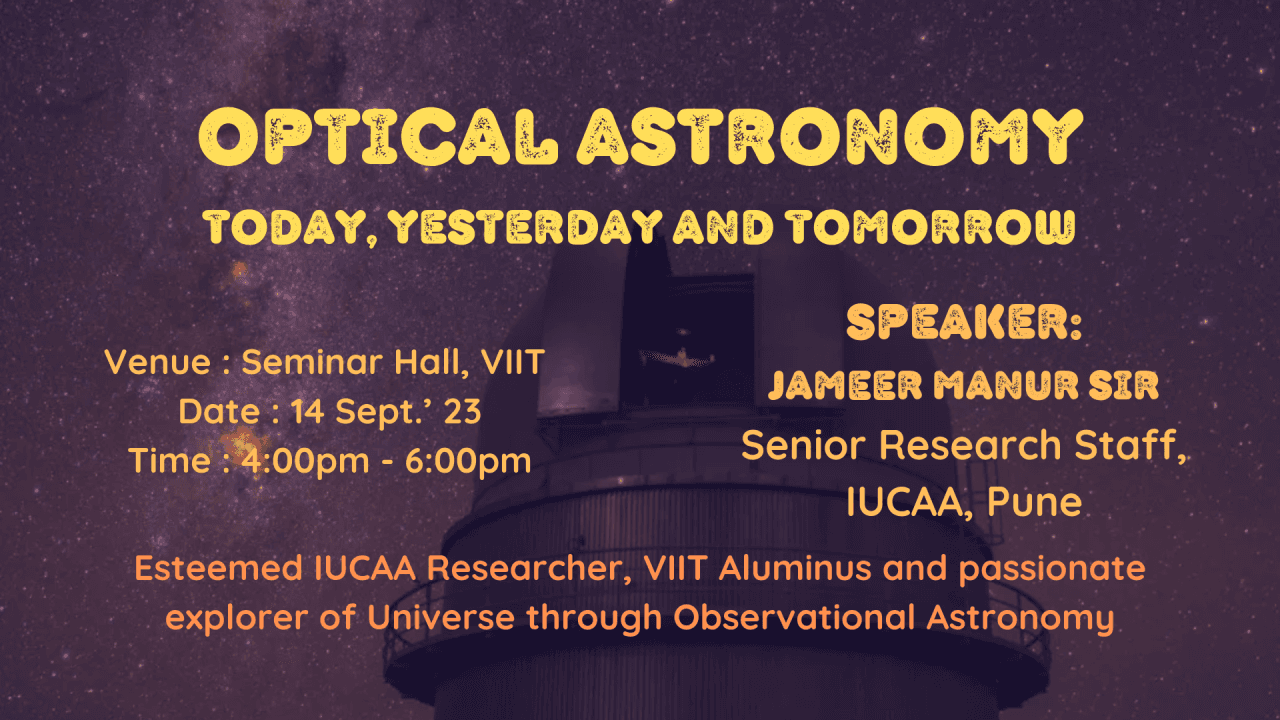
Resource persons: Jameer Manur , Ravi Kesharwani , T. R.Saravanan
Locations: TLC - IUCAA, Pune

Introduction
On April 8, 2025, a group of 16 students had the opportunity to visit the Inter-University Centre for Astronomy and Astrophysics IUCAA, Pune, India in Pune. The visit was all about getting a closer look at the institute, exploring its advanced facilities, and learning about the exciting research happening in astronomy and astrophysics. The day began at the Teaching and Learning Centre (TLC) building, where the students were welcomed before setting off on a series of interactive sessions and demonstrations. Guided by IUCAA’s scientists and researchers, the group got a chance to engage with real-world applications of astrophysics and experience the atmosphere of a leading research hub.

1. Session on SUIT Payload by Mr. Ravi Kesharwani
The first session was led by Mr. Ravi Kesharwani, who introduced the students to the Solar Ultraviolet Imaging Telescope (SUIT), one of the most important instruments on board Aditya-L1, India’s first solar observatory in space. He explained how SUIT helps scientists study the Sun in ultraviolet light, covering wavelengths between 200–400 nm, with remarkable precision thanks to its 1.4 arcsecond angular resolution.
What made the session especially engaging was the way Kesharwani Sir connected the technical details with real challenges faced in space missions. He walked the students through the rigorous testing process that the payload must endure — from vibration and shock tests to ensure it can survive the rocket launch, to thermal vacuum (TVac) tests that simulate the harsh environment of space. He even shared visuals of SUIT during these tests, along with tables of actual vibration data, giving students a behind-the-scenes look at how a payload is prepared before being sent into orbit.

2. LIGO Laboratory Session with Prof T. R. Saravanan
Next, the students stepped into the LIGO India (Laser Interferometer Gravitational-Wave Observatory) lab, where Mr. T. R. Saravanan, a Senior Technical Assistant at IUCAA, welcomed them. He had a way of explaining things that instantly grabbed everyone’s attention. Instead of diving straight into heavy physics, he described gravitational waves as ripples in space-time, like the tiny waves you see spreading out when a stone is dropped into water. From there, he explained how the interferometer detects these ripples by using a laser beam to measure unimaginably small shifts in the distance between mirrors. In this session, the students not only learned about the experimental setup but were also shown live readings from the detector. Mr. Saravanan explained to the students how to understand the data. He explained that we could actually tell how strong a gravitational wave is just by looking at its shape on the screen. The students were amazed to learn that these shifts are so tiny, they’re smaller than a fraction of a proton.
Saravanan Sir emphasized the sensitivity of the LIGO detector, explaining that it is capable of detecting changes in distance smaller than the diameter of a proton. He described how the entire setup is carefully isolated from external disturbances, such as seismic vibrations, through the use of specialized damping systems.

3. Guidance from Jameer Manur Sir
In the lab, we got the chance to interact with Jameer Manur Sir, who guided us through some fascinating experiments that connected directly to what we’ve studied in physics and astronomy. He mentioned Faraday Rotation, telling us how a magnetic field can actually rotate the polarization plane of light. He told us there are various antennas, like a Horn Antenna and an Antenna Trainer Kit. He highlighted that the unique flared shape of the horn antenna allows it to efficiently capture or direct electromagnetic waves in a specific direction. Sir also introduced us to the concept of Cosmic Ray Muon Detection, explaining how these tiny subatomic particles from outer space constantly reach Earth and how they can be detected in the lab. It was fascinating to learn that such particles are all around us and that they can actually be observed with the right instruments. Jameer Sir also delved into the topic of imaging and how our eyes perceive color. He explained the concept of RGB (Red, Green, Blue) and how the human brain combines these primary colors to form the full spectrum of colors we see.


4. Sunspot Observation
The visit concluded with a memorable session where students used a specially filtered telescope to safely observe the sun. They were able to see sunspots, which are temporary, cooler regions in the sun's photosphere.

Conclusion:
The visit to IUCAA, a successful initiative by Antariksh - The Astronomy Club, proved to be an invaluable learning experience for the 16 students. The combination of expert-led presentations and demonstrations effectively introduced the students to the world of professional astronomy and astrophysics. The visit not only provided academic insights but also inspired the students by showcasing potential future avenues for research and careers in the field.