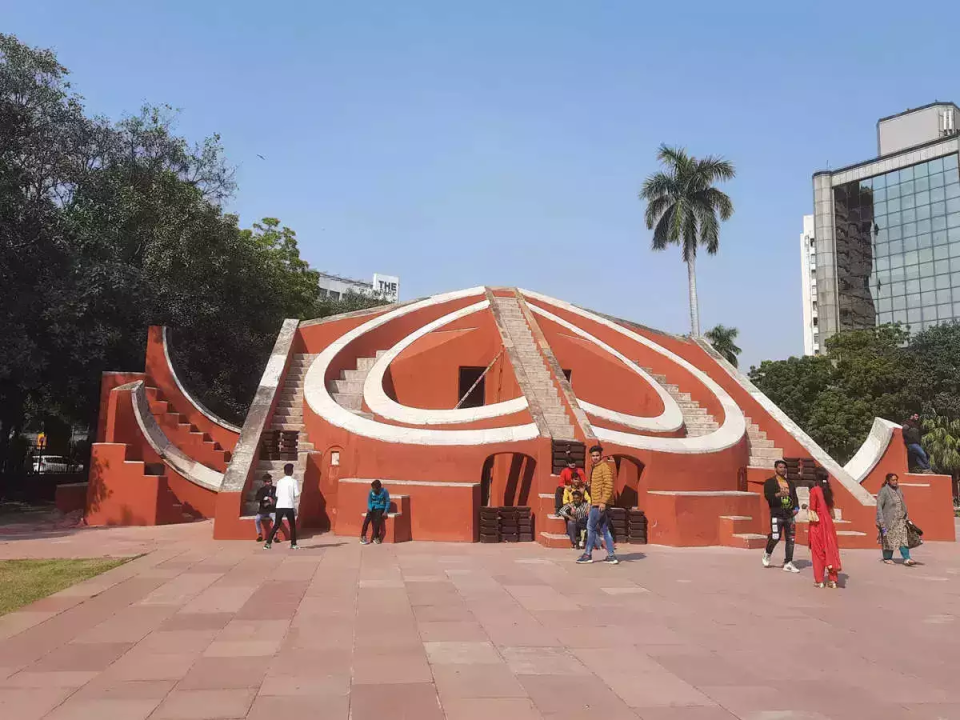
Nestled in the heart of Jaipur, Rajasthan, stands a remarkable testament to India's scientific heritage and architectural ingenuity - Jantar Mantar. This awe-inspiring astronomical observatory, built in 1734 by the visionary Rajput Maharaja Sawai Jai Singh II, is a living testament to the advanced knowledge possessed by ancient Indian astronomers. With 19 stone instruments designed to measure time and interpret celestial positions, Jantar Mantar continues to captivate visitors with its ancient wisdom and precision. In this article, we will delve into the historical significance of Jantar Mantar, explore its architectural brilliance, and examine the praise it has garnered from experts and renowned organizations.
Historical Significance
Maharaja Sawai Jai Singh II, a polymath and an avid astronomer, sought to advance astronomical research and mathematical precision during his reign. As part of his grand vision, he constructed five observatories across India, each serving as a hub for scientific observations [2]. Among these, Jaipur's Jantar Mantar is the largest and most well-preserved.
Architectural Brilliance
The architectural brilliance of Jantar Mantar is a testament to the ingenuity and sophistication of ancient Indian astronomers. The observatory boasts a collection of intricate stone instruments, each meticulously designed to calculate planetary positions and interpret celestial phenomena. These remarkable instruments are marvels of precision engineering and stand as a testament to the advanced scientific thinking of their time.
Vrihat Smarat Yantra
At the heart of Jantar Mantar lies the Vrihat Smarat Yantra, a towering sundial that commands attention with its impressive height of 27 meters. Scholars and scientists alike praise its precision, as it can measure time with an astonishing accuracy of two seconds. This monumental sundial is not only an architectural marvel but also a scientific wonder that showcases the ancient Indians' understanding of time and astronomical principles. "Vrihat Smarat Yantra, measuring a height of 27 m, making it the world’s tallest sundial. The instrument’s precision is worthy of praise. It measures time up to the precision of two seconds!" [2]
Laghu Smarat Yantra
Adjacent to the Vrihat Smarat Yantra stands the Laghu Smarat Yantra, a smaller sundial equipped with a ramp that points towards the North Pole. This clever design allows visitors to calculate Jaipur's local time by observing the shadow cast on finely divided scales. The Laghu Smarat Yantra's integration with the larger sundial adds to the observatory's overall functionality and efficiency. "A smaller sundial, called Laghu Smarat Yantra, has a ramp that points towards the North Pole; so if you were to calculate Jaipur time, you can look at the ramp’s shadow on the fine divisions carved on a scale next to it." [2]
Ram Yantra
The Ram Yantra is another intriguing structure within Jantar Mantar, offering a unique method of determining the direction of the Sun and other celestial bodies. The design includes poles and scales inscribed on its interior walls, providing a practical tool for astronomers to study the motion of celestial objects and their positions relative to the observer on Earth. "The Ram Yantra – this structure tells you the direction of the Sun and other planets with the help of poles of equal height at the center, and scales inscribed in the interior walls of the structure." [2]
Jaya Prakash
Among the many fascinating instruments at Jantar Mantar is the Jaya Prakash Yantra, a masterpiece consisting of two hemispherical marble bowls. This extraordinary instrument enables precise measurements of the positions and elevations of planets and other celestial bodies. When the inverted image of the sky falls on its surface, the Jaya Prakash Yantra reveals crucial astronomical data, making it an invaluable resource for ancient astronomers. "There is Jaya Prakash Yantra that consists of two hemispherical marble bowls. When the inverted image of the sky falls on the structure, it gives the exact position and elevation (among many other things) of the planets and other heavenly bodies! Exact!" [2]
Digamsa
Lastly, the Digamsa stands as a pillar with concentric outer circles, offering a means of predicting sunrise and sunset. This ingenious design allows astronomers to track the Sun's movements and anticipate the transitions of day and night with remarkable accuracy. "Another such fascinating instrument is the Digamsa, a pillar, with the help of two concentric outer circles, which helps predict sunrise and sunset. Go figure." [2]
The architectural brilliance of Jantar Mantar is a symphony of mathematical precision, artistic finesse, and scientific acumen. The observatory's stone instruments serve as a testament to the advanced knowledge and understanding of celestial mechanics possessed by ancient Indian astronomers. Today, visitors from around the world marvel at Jantar Mantar's sophisticated structures, gaining profound insights into the astronomical wisdom that has stood the test of time. As a UNESCO World Heritage Site, Jantar Mantar continues to inspire and educate, preserving India's rich astronomical heritage for generations to come.
Scholarly Praise
"The observatory at Jaipur's Jantar Mantar stands as a testimony to the unparalleled astronomical knowledge and engineering skills of ancient India. The precision and complexity of its stone instruments continue to fascinate experts and visitors alike, offering insights into the advanced scientific thinking that prevailed in the 18th century." [1]
"Built in 1734, Jantar Mantar is a scientific and architectural marvel that has stood the test of time. Its collection of stone instruments leaves visitors in awe, showcasing the genius of ancient Indian astronomers." [2]
"The Jantar Mantar in Jaipur is an astronomical observatory that transcends time, taking visitors on a journey back to the era of Maharaja Sawai Jai Singh II. The observatory's stone instruments are not only a scientific wonder but also an artistic representation of celestial phenomena." [3]
"The UNESCO inscription of Jantar Mantar as a World Heritage Site is a testament to its outstanding cultural and scientific significance. This accolade acknowledges the observatory's role in preserving India's rich astronomical heritage for future generations." [4]
Jaipur's Jantar Mantar stands as a living tribute to India's scientific heritage. Its stone instruments continue to inspire awe and admiration for the advanced knowledge possessed by ancient Indian astronomers. Jantar Mantar's architectural brilliance and recognition as a UNESCO World Heritage Site cement its place as a symbol of India's rich cultural and scientific legacy, inviting the world to appreciate the brilliance of human intellect that existed centuries ago.
Antariksh Club of VI
Antariksh Club, an Inter-Institutional Student's Club, is dedicated to promoting and spreading awareness about Astronomy and Astrophysics among students. The club organizes major events like Star Parties and invites eminent guests to deliver guest lectures, providing valuable insights into the field. Additionally, Antariksh Club conducts internal lectures and group discussions to foster a community of like-minded individuals passionate about astronomy. The club also actively participates in workshops and exhibitions, collaborating with institutions like IUCAA to further enrich its members' knowledge and understanding of the cosmos. Through its various activities, Antariksh Club seeks to showcase the marvel of Jaipur's Jantar Mantar and highlight its significance in the realm of astronomical observation and ancient Indian scientific prowess.
References:
[1] “Jantar Mantar Observatories as Teaching Laboratories for Positional Astronomy” by N. Ratnasree, Indian Academy of Sciences. [https://www.ias.ac.in/article/fulltext/reso/022/03/0201-0212]
[2] Precious Rongmei. (May 6, 2022). “The marvel that is Jaipur's Jantar Mantar.” [https://timesofindia.indiatimes.com/travel/destinations/the-marvel-that-is-jaipurs-jantar-mantar/articleshow/91352932.cms]
[3] Shalbha Sarda. (31st May 2022). “India's mysterious gateway to the stars” [https://www.bbc.com/travel/article/20220530-jantar-mantar-indias-mysterious-gateway-to-the-stars]
[4] UNESCO World Heritage Convention “The Jantar Mantar, Jaipur” [https://whc.unesco.org/en/list/1338/]