
7- Large Telescopes and Space Astronomy Missions
Prof. Ajit Kembhavi's lecture provided an in-depth exploration of modern astronomical techniques, focusing on the impact of Earth's atmosphere on observations and advancements in telescope technology. He discussed adaptive optics, which compensates for atmospheric distortions, and highlighted significant telescopes like the Keck and the upcoming 30 Meter Telescope. Prof. Kembhavi emphasized India's growing role in global astronomy, showcasing contributions from institutions like the Indian Institute of Astrophysics. He also covered space missions, including the Mars Orbiter and Astrosat, and upcoming initiatives like the Aditya mission, underscoring the importance of technological innovations for advancing our understanding of the universe.
| Published on 30 Jul 2023

2- UV, Optical, IR Astronomy
This lecture explores the mechanics of tracking celestial objects with telescopes, emphasizing the impact of Earth's rotation and the complex adjustments required to maintain focus. Using an Altazimuth mount, telescopes like the Gemini (with its 8-meter mirror) face engineering challenges related to weight, stability, and alignment, especially in mountain environments with wind and temperature variations. Additionally, atmospheric turbulence impacts observation quality, causing a phenomenon known as "atmospheric seeing," where turbulent air distorts light, degrading image clarity. Advances in technology continue to improve telescope designs, allowing more precise astronomical observations despite environmental challenges.
| Published on 30 Jul 2023

6- Ripples in Space-Time
LIGO India is a groundbreaking initiative aimed at enhancing gravitational wave astronomy by improving detection and localization of cosmic events. Established under the Indian Initiative in Gravitational Wave Observations, it addresses limitations of existing detectors by introducing a third observatory that significantly refines triangulation capabilities. The project promises advancements in astrophysics, fundamental science, and technology, while also fostering interdisciplinary research and collaboration. As construction progresses, LIGO India is set to revolutionize our understanding of the universe, paving the way for new discoveries and educational opportunities for students and researchers in various fields.
| Published on 30 Jul 2023

Interesting Aspects of Chandrayaan-3 -----Mr. Suresh Naik Sir
On July 21, 2023, the Antariksh Club at Vishwakarma Institutes hosted an invited talk by former ISRO Group Director Mr. Suresh Naik at VIT, Pune. The event, part of the Faculty Development Programme, attracted over 300 attendees, including faculty and students. Mr. Naik's engaging lecture covered rocket design, Chandrayaan missions, and the discovery of water on the Moon. The interactive session allowed attendees to ask questions about India's space journey and future policies. The successful event highlighted the club's commitment to fostering scientific curiosity and appreciation for space exploration.
| Published on 21 Jul 2023

Antariksh Club of VI's Spectacular Live Presentation of Chandrayaan-3 Lunar Landing
On September 16, 2023, the Antariksh Club hosted an engaging talk by Harsh Jalnekar at Vishwakarma Institute, focusing on the "Death of a Star and Introduction to Black Holes." Attendees explored the dramatic endings of stars, including supernovae, hypernovae, and kilonovae, and learned about stellar remnants like white dwarfs and neutron stars. The presentation also delved into black holes, active galactic nuclei, and quasars, illustrating their cosmic significance. A lively Q&A session addressed topics like star naming conventions and the differences between pulsars and magnetars, leaving participants with a deeper appreciation of the universe's mysteries.
| Published on 21 Jul 2023
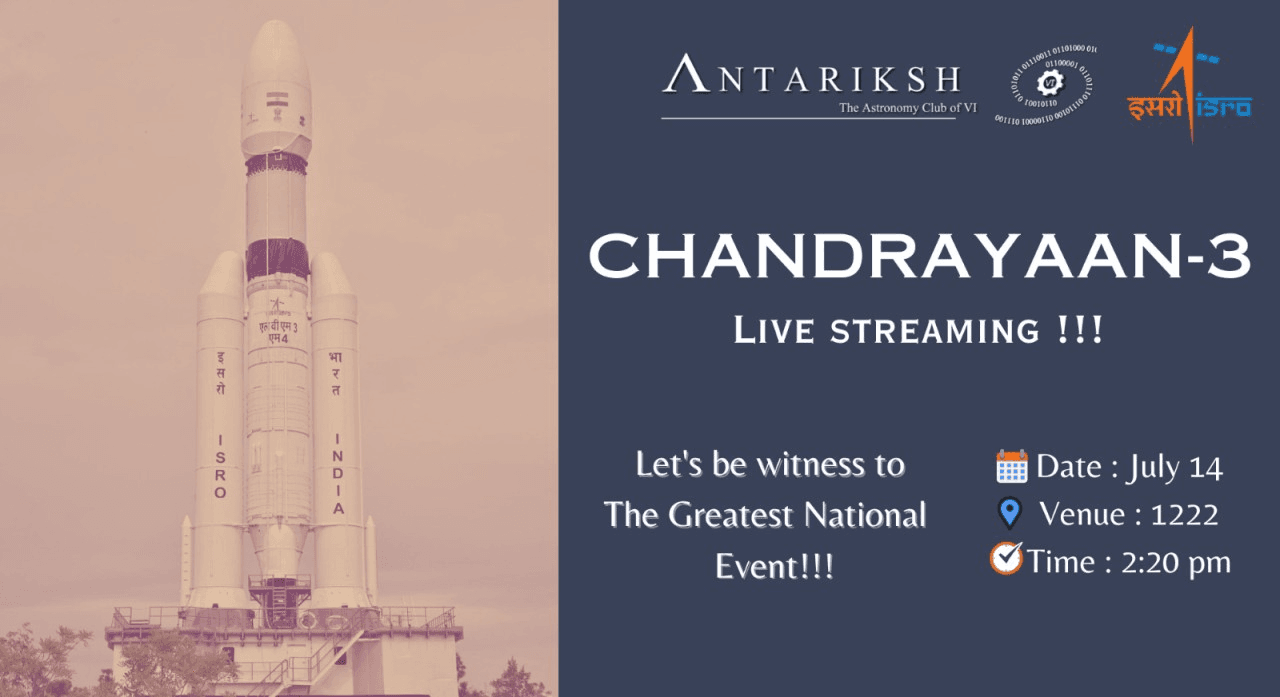
🚀 Celebrating the Successful Session: Chandrayaan-3 Launch 🌕
The Antariksh Club successfully hosted a live streaming event of the Chandrayaan-3 launch at Vishwakarma Institute of Technology on July 15, 2023. Over 60 students gathered to celebrate India's achievements in space exploration, creating an electric atmosphere filled with enthusiasm and national pride. The event emphasized teamwork, dedication, and the invaluable support of mentors, including Prof. Dr. Shripad Bhatlawande, Jameer Manur, and Dr. Shital Raut. The Antariksh Club aims to ignite curiosity in astronomy and inspire future generations of scientists and engineers.
| Published on 14 Jul 2023