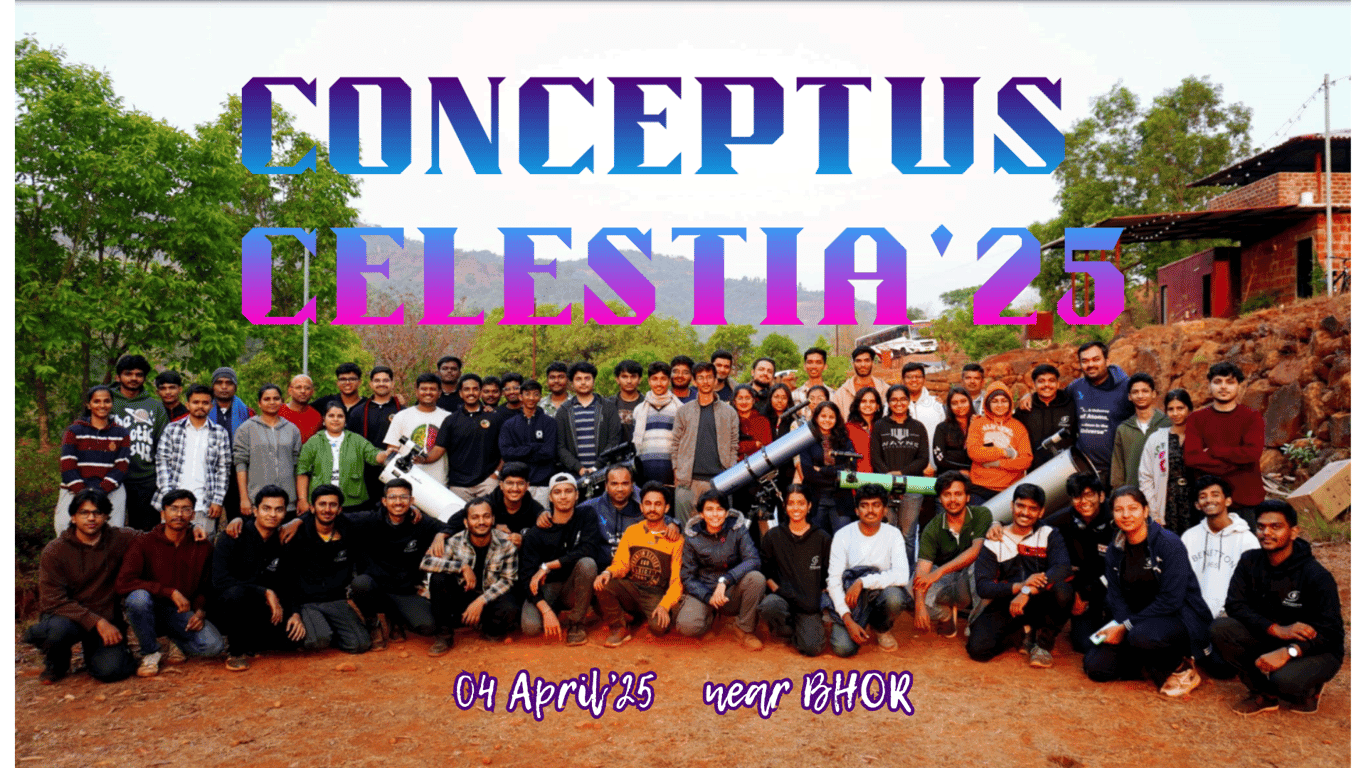
Conceptus Celestia 2025
Conceptus Celestia was a public ‘Star Party’ event organized by the Antariksh club of VI. Held on the 4th of April and extending into the morning of the 5th, the event took place at Chandavne nights camping, a secluded and dark location approximately 64 kilometers from Pune, ensuring minimal light pollution for optimal night sky observation. The event was a resounding success, enjoyed by 80 attendees who had the opportunity to observe constellations, deep sky objects, and participate in two insightful sessions led by Sir Jameer Manur and Pranav Pujari.
| Published on 13 Apr 2025

IUCAA Visit
An unforgettable visit to IUCAA, Pune! The Antariksh Club of VI recently took 16 students on a field trip to the Inter-University Centre for Astronomy and Astrophysics. We learned about the Aditya-L1 mission's SUIT payload from Mr. Ravi Kesharwani and witnessed live data from the LIGO India lab with Mr. T. R. Saravanan. The highlight was hands-on learning with Jameer Manur Sir, who guided us through fascinating experiments on Faraday Rotation and Cosmic Ray Muon Detection. The visit concluded with a breathtaking view of sunspots through a special telescope. A truly inspiring experience!
#IUCAA #Astronomy #Astrophysics #SpaceScience #AdityaL1 #LIGOIndia #AntarikshClubVI #EducationalVisit
| Published on 07 Apr 2025

gggg
| Published on 27 Feb 2025
1- Foundations of Precision Measurement
Precision measurement is crucial in scientific research for ensuring reliable data, which drives experimental accuracy and technological advancement. Historically, measurement methods have evolved significantly, from rudimentary ancient tools to modern standards like the metric system and the International System of Units (SI). Measurement types—such as length, time, and mass—each require specific techniques, ranging from rulers to atomic clocks, which aid in achieving accuracy.
Standards like SI units ensure consistency and comparability across global laboratories. Measurement uncertainty, which quantifies the range within which the true value is expected to lie, is essential in precision. Uncertainty is typically measured through two methods: Type A (statistical analysis) and Type B (external sources). Combining these uncertainties offers a comprehensive uncertainty measurement, critical for data reliability.
In the future, as technology and fields like quantum mechanics progress, demand for even greater measurement precision will increase, potentially leading to new methodologies. This understanding enables scientists to effectively interpret findings and enhances collaboration across disciplines.
| Published on 22 Dec 2024

Time Dilation, Length Contraction and the Bending of Light
Fundamentals of light have been the origin of many abstract and unique phenomena in our universe, like time dilation, length contraction and gravitational lensing, to name a few. Multiple experiments, along with deductions from astronomers and scientists like A. Einstein, P. Fermat and more, have been able to provide a cohesive understanding of these happenings. This paper thus goes to review and put together the correlation and logical overlap of such topics, from the bending of light (refraction) in contrast to the “bending” of light in space.
| Published on 10 Dec 2024

Neutron Stars: The Dense Giants of the Universe
In this article we will explore the world of neutron stars, how massive dying stars undergo extreme transformation. From their first theoretical prediction to their effects on gravitational waves. We will further investigate the structure of the neutron star, from its thin atmosphere to its mysterious core. This article also examines their extreme physical features, including rotation, gravity, mass, and magnetic field. It also explores different types of neutron stars and their behavior in space. India’s contribution to this story is also discussed, focusing on institutes like TIFR and IUCAA, missions like ASTROSAT, and advanced observatories like GMRT.
| Published on 03 Dec 2024